Supporting state and local leadership in public health communications
About
The U.S. Health Communications Initiative (HCI) is a nonpartisan, state-centered communications infrastructure built to help states lead on public health messaging. Coordinated by the public health nonprofit PGP, the initiative works with states to provide community-based partners with tools, data, and tailored communications.
Materials are available in multiple languages and are unbranded and free of attribution. These communications reach prioritized populations through their trusted messengers at a cadence that allows for both quick responses and longer-term campaigns.
The HCI is a system for health communications and is being used for issues such as vaccines, mental health, STIs, firearm safety, family planning, opioids and substance use, and climate and health.
Our partners


A model that strengthens state capacity
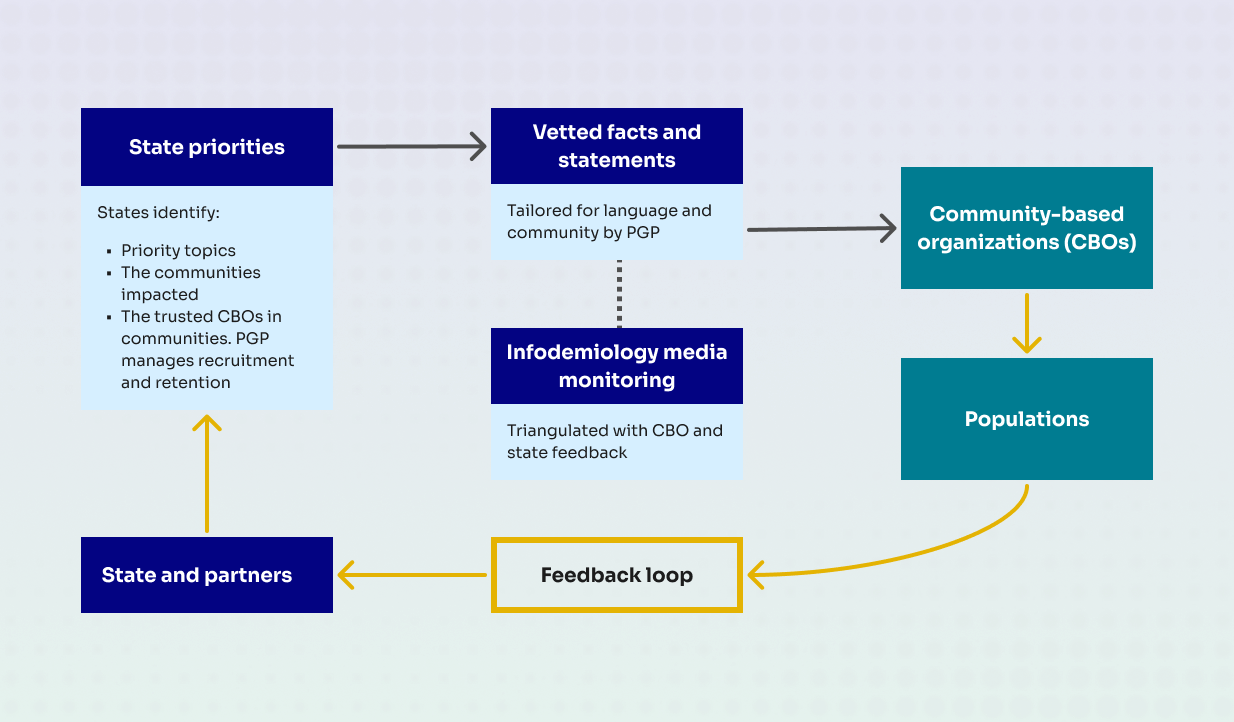
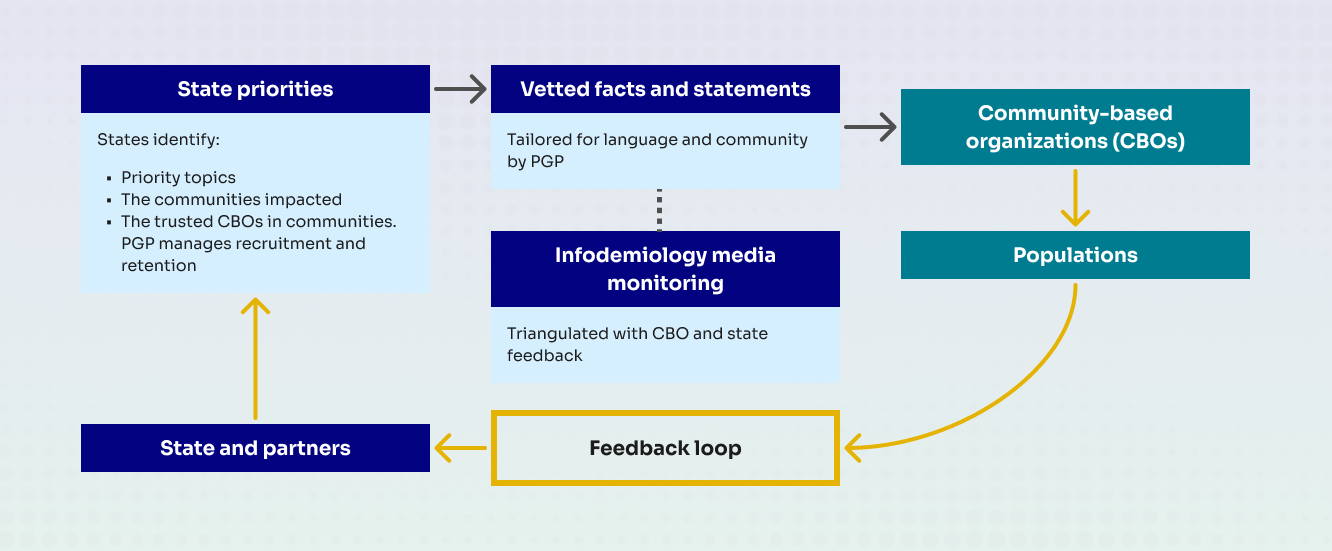
The HCI is designed in partnership with state government but operates independently, allowing it to:
- Rapidly respond to local needs and real-time information gaps.
- Engage directly with trusted community-based organizations (CBOs) on behalf of state priorities. Regular feedback from CBOs goes to states.
- Accept funding from public and vetted private sector partners to support long-term sustainability.
Messaging priorities are set by states. Leveraging best practices in infodemiology, PGP’s media monitoring, analysis, and vetted materials are aligned to amplify the state’s chosen focus areas—delivered through a network that includes the community-based organizations state and local health departments can readily identify. PGP works with states to organize their existing relationships into their own HCI model. At the national level, the U.S. HCI supports states by mirroring their communications priorities through a national network of hundreds of high-trust CBOs.
A trusted, scalable solution

Provides a central resource hub with multilingual, ready-to-share materials used by CBOs and partners. Most materials are unbranded and require no attribution, allowing partners to adapt them as needed.
Offers regular communications training and office hours to build local capacity.
Conducts real-time and retrospective narrative monitoring to identify emerging issues and inform messaging.
Fosters an ongoing feedback loop from community leaders.
Integrates with a large and ever-growing national network.
Meeting the moment
As states assume greater leadership in public health, the HCI offers an immediately deployable solution that complements government authority, can fill critical gaps, and can strengthen a state’s connection with the communities it serves.
Two states, Michigan and Minnesota, are prepared to speak to their experience with the HCI. Please contact PGP using the form below, and we will connect you:
Get in touchSelect HCI examples

Originally created by the CDC Foundation in 2021, and incorporated into the HCI in 2025, the Vaccine Resource Hub functions as the nation’s largest hub for vaccine communications designed for CBOs, with content in over 50 languages.


In partnership with the Michigan Association for Local Public Health and the Public Health Advisory Council, this initiative provides support to CBOs and partners across six health topics, with content developed in English, Spanish, and Arabic.

In partnership with the Minnesota Department of Health, this initiative focuses on infectious disease and vaccine-related topics, with content for CBOs and partners developed in English, Spanish, and Somali.
Support for the initiative
The U.S. HCI is supported by grants and organizations committed to timely, accurate, and accessible health information for all communities. These include state governments, foundations, professional associations, payers and providers, large employers, and private funders. If you’re interested in supporting these efforts, contact us using the form below.
Get in touch
Interested in learning more about the initiative or how we can work together? Contact us below.
